

What Does Idiom Mean? Definition, Examples and Origins
If someone says "it's raining cats and dogs", no animals are falling from the sky. If a friend tells you to "break a leg" before a performance, they are wishing you good luck — not an injury. Welcome to the strange world of idioms, where words almost never mean what they seem to say.
So what does idiom mean, exactly? And how do you tell an idiom from an ordinary phrase? This guide gives you a clear definition, the main types of idioms, plenty of everyday examples, and the surprising stories behind some of the most famous ones.
The short answer: An idiom is a fixed group of words whose meaning is different from the literal meaning of the words in it. "Break the ice" does not involve ice — it means to ease social awkwardness and get people talking. You cannot work out an idiom's meaning by translating its words one by one; you have to learn the whole phrase as a single unit, just as you would learn a single word.
Table of Contents
The definition of an idiom
The Cambridge Dictionary defines an idiom as “a group of words in a fixed order that has a particular meaning that is different from the meanings of each word on its own.” That fixed order matters: you can say “break the ice”, but “break the frozen water” is not an idiom — it is just a strange sentence.
Idioms are part of what linguists call figurative language — language that means something beyond its literal words. They are different from single words because they are made of several words, and different from free phrases because their meaning is fixed by custom. Nobody voted on what “spill the beans” means; English speakers simply agreed, over centuries, that it means to reveal a secret.
Three features mark a true idiom. First, its meaning is not predictable from its words — knowing “kick” and “bucket” does not tell you that “kick the bucket” means to die. Second, its words are mostly fixed — you cannot swap in synonyms and keep the meaning. Third, it belongs to a particular language and culture: every language has idioms that make no sense when translated word for word.
Idioms vs phrases: what is the difference?

Every idiom is a phrase, but not every phrase is an idiom. A phrase is simply a group of words that works together, like “in the morning” or “a cup of coffee”. These phrases mean exactly what their words say. An idiom means something else entirely.
Here is a quick test. Take the phrase “under the weather”. Literally, it would mean standing beneath the weather — which is nonsense. As an idiom, it means feeling slightly ill. Now take “under the table”. That is a phrase, not an idiom: it means exactly what it says. The test is simple: if the words add up to the meaning, it is a phrase. If they do not, it is probably an idiom.
There is also a difference between idioms and proverbs. A proverb is a complete piece of advice, like “a stitch in time saves nine” — it tells you something wise. An idiom is usually part of a sentence, not a whole lesson: “the project is on thin ice” uses an idiom inside a larger sentence. And unlike slang, which is informal and often short-lived, idioms can be centuries old and used in formal writing too.
Common idioms you hear every day

Idioms are everywhere in English — in films, songs, news headlines and everyday conversation. Here are some of the most common, grouped by what they mean:
Starting and social situations: – Break the ice — to ease awkwardness and get people talking at the start of a meeting or party. – Hit it off — to get along well with someone immediately. – Break the news — to tell someone something important, often bad news.
Difficulty and effort: – Bite the bullet — to face something unpleasant with courage. – Burn the midnight oil — to work or study late into the night. – Hit the nail on the head — to say exactly the right thing.
Money and value: – Cost an arm and a leg — to be very expensive. – Break the bank — to cost more than you can afford. – A penny for your thoughts — a friendly way of asking what someone is thinking.
Secrets and truth: – Spill the beans — to reveal a secret. – Let the cat out of the bag — also to reveal a secret, usually by accident. – Read between the lines — to understand a hidden meaning.
Luck and chance: – Break a leg — good luck, said to a performer before going on stage. – The ball is in your court — it is your turn to act or decide. – A blessing in disguise — something that seems bad at first but turns out to be good.
Notice how many of these use the body, animals, weather or everyday objects — ice, beans, cats, bullets, nails. Idioms grow out of daily life, which is why their origins are often so interesting.
Where do idioms come from?
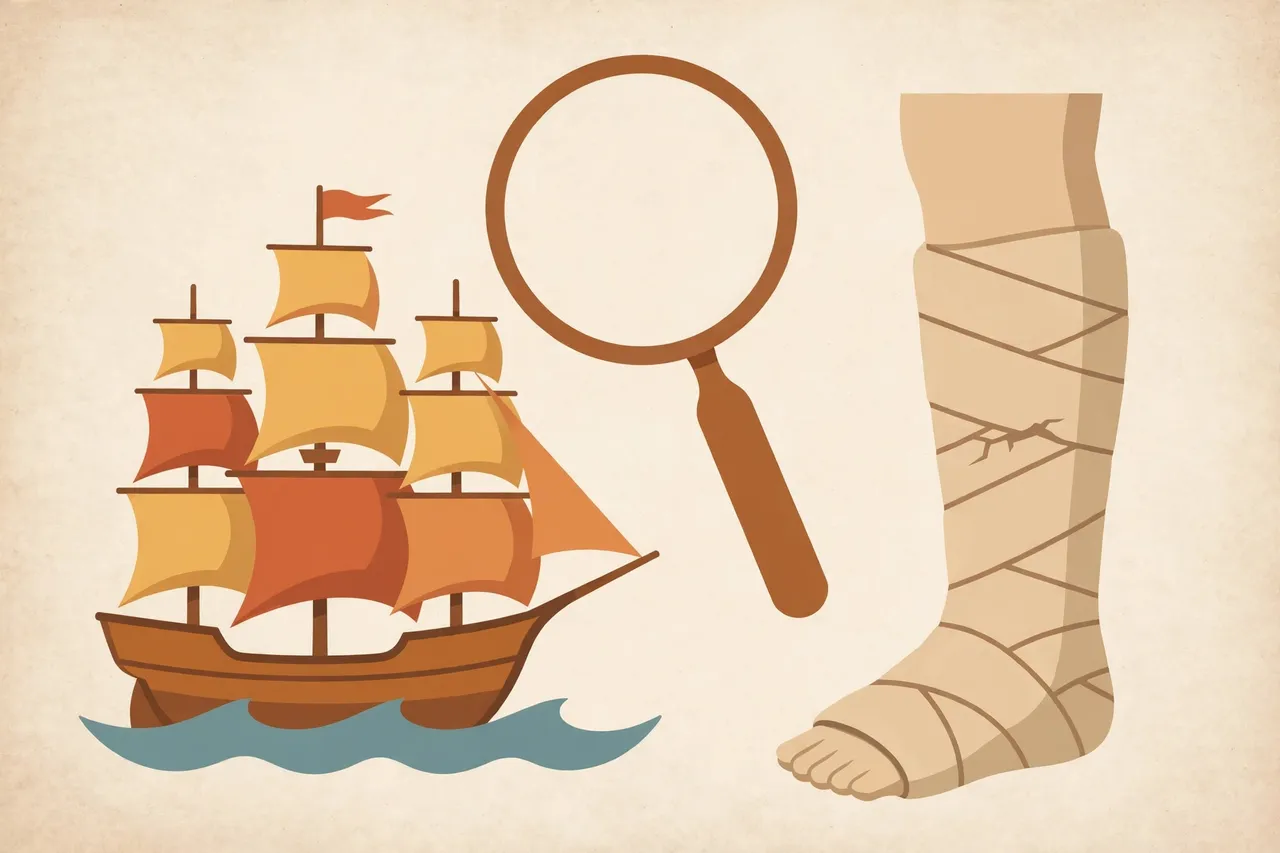
Idioms are fossils of history: each one preserves a piece of the world it came from. Many English idioms come from the sea. “Three sheets to the wind” (very drunk) comes from sailing, where a loose sheet — a rope controlling a sail — made a ship wobble like a drunk person. “To be in the same boat” (in the same difficult situation) and “to run a tight ship” (to manage something strictly) are also sailors’ phrases.
Others come from the military and old trades. “Bite the bullet” may come from soldiers biting a bullet during surgery before anaesthetics existed. “Break the ice” comes from icebreaker ships clearing a path through frozen water — just as a good host clears a path through social awkwardness. “The whole nine yards” is often said to come from tailoring or from machine-gun belts, though its true origin is still debated by experts.
Some idioms come from literature. Shakespeare gave English “break the ice”, “in a pickle” and “wear your heart on your sleeve”. The Bible contributed “the writing on the wall” and “a thorn in the flesh”. And some are much newer: “think outside the box” appeared in business language in the 1970s, and “on the same page” became common with modern office work.
The honest truth is that for many idioms, the origin is uncertain. Experts disagree, stories get exaggerated, and some popular explanations are myths invented long after the phrase existed. When an origin cannot be proven, good dictionaries say so — and so should anyone explaining idioms.
How to learn and use idioms
The best way to learn idioms is the way native speakers learn them: in context, not from lists. When you hear an idiom in a film, a song or a conversation, note the whole sentence it appeared in — the situation is what fixes the meaning in your memory. A list of 100 idioms memorised in one evening will mostly be forgotten by next week; ten idioms met in real sentences will stay.
Use idioms sparingly in your own speech and writing. One idiom in a paragraph adds colour and sounds natural. Five in one sentence sounds forced, and risks using one wrongly — which native speakers notice immediately. And be careful with register: some idioms are casual (“piece of cake”), some are formal (“the ball is in your court”), and using a casual idiom in a formal email can sound careless.
Finally, do not translate idioms word for word between languages. Every language has its own idioms, and a direct translation usually produces nonsense. “It’s raining cats and dogs” translated literally into another language would baffle everyone. Learn the idiom as a whole, with its meaning and its situation — that is how it lives in the language.
For a much bigger collection to explore, see our hub post of 100 idioms and their meanings — it groups idioms by theme and gives a short, clear meaning for each one. You can also browse more word stories in our Words & Meanings category.
Frequently asked questions
Conclusion
An idiom is a phrase that means more — or something quite different — than its words suggest. “Break the ice”, “spill the beans”, “under the weather”: each one is a small piece of history, frozen into everyday speech. Learn them in context, use them sparingly, and never translate them word for word. And when you meet a new one, ask what situation it belongs to — that is usually the fastest way to understand it, and to remember it.
Sources: Cambridge Dictionary — idiom — https://dictionary.cambridge.org/dictionary/english/idiom; Oxford Learner’s Dictionaries — idiom — https://www.oxfordlearnersdictionaries.com/definition/english/idiom
What does idiom mean in simple words?
An idiom is a fixed phrase whose meaning is different from the meanings of the words in it. For example, “break the ice” means to ease social awkwardness — it has nothing to do with real ice. You have to learn idioms as whole phrases.
What is an example of an idiom?
“Spill the beans” is a classic example — it means to reveal a secret. Other common examples include “break a leg” (good luck), “under the weather” (feeling ill) and “cost an arm and a leg” (very expensive).
How is an idiom different from a phrase?
A phrase means what its words say, like “in the morning”. An idiom means something different from its words, like “under the weather” meaning slightly ill. Every idiom is a phrase, but most phrases are not idioms.
Can idioms be translated literally into other languages?
Usually not. Idioms belong to a specific language and culture, so a word-for-word translation normally makes no sense. Each language has its own idioms for similar ideas, and they must be learned separately.
Why do we use idioms?
Idioms make language colourful, vivid and efficient. They pack a whole idea into a short, familiar phrase, and they signal that the speaker belongs to the language community. They also appear constantly in films, books and everyday speech, so understanding them is essential for fluency.
How many idioms are there in English?
Nobody knows exactly, because new idioms appear and old ones fade. Dictionaries list thousands, and some estimates put the number above 10,000. You do not need to know them all — the few hundred most common ones cover almost everything you will hear.